A good stack looks like it happened by accident. In reality, it usually follows a few quiet rules about length, weight and spacing. Learn them once and you can pull together necklaces, earrings, rings and bracelets in the morning without standing in front of the mirror untangling chains.
Start with necklace lengths
Necklace layering lives or dies on length. If two chains sit at the same point on your chest, they will tangle and blur into one line. Most jewelers use roughly these standard lengths, measured end to end:
- 14 to 16 inches: choker to collarbone, the top layer of most stacks.
- 18 inches: the most common length, landing just below the collarbone.
- 20 to 24 inches: around the top of the chest, ideal for a pendant.
- 28 inches and longer: long chains that work best alone or as a single bottom layer.
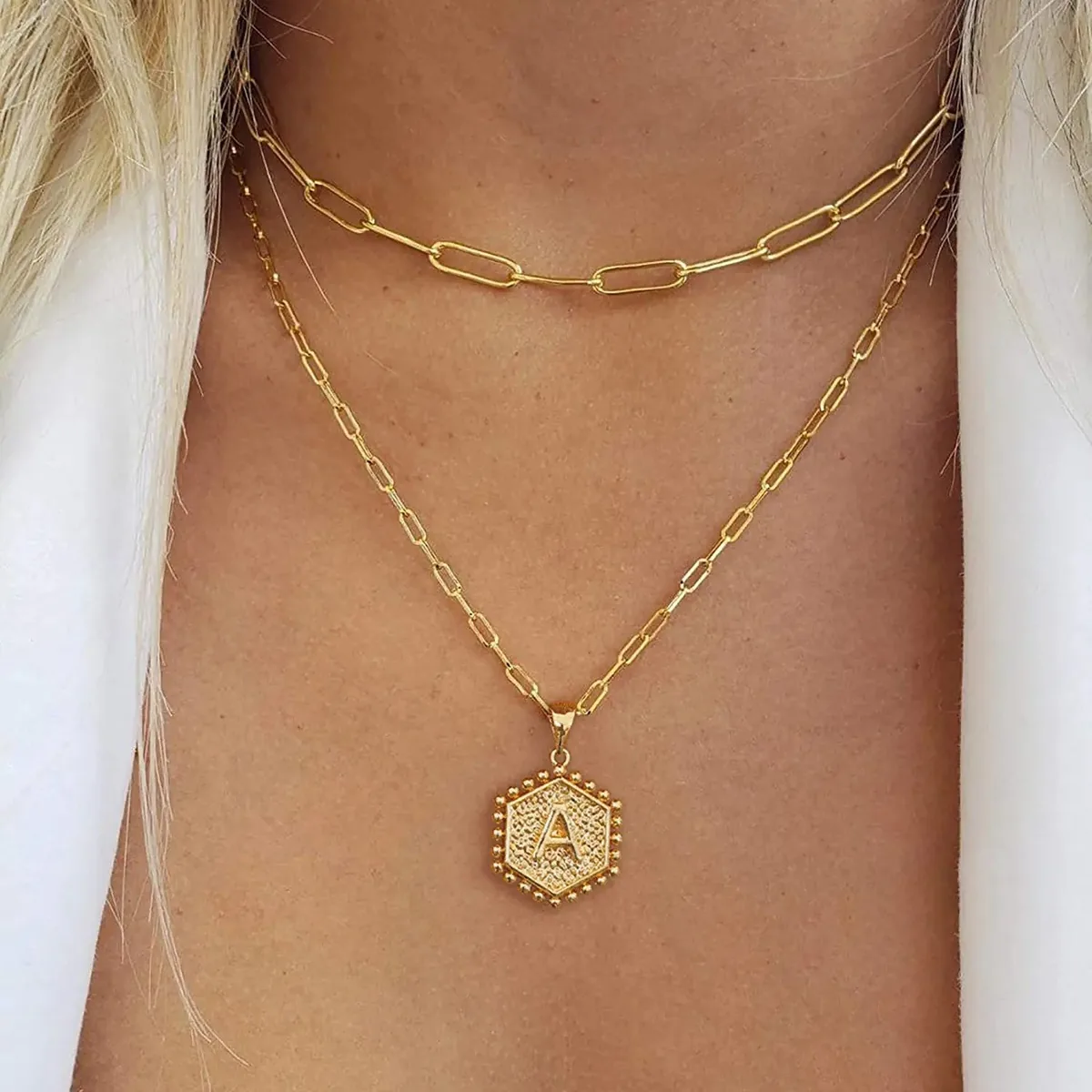
Aim for about two inches between each layer. A classic trio is 16, 18 and 20 inches; a pair of 16 and 20 inches gives a cleaner, more spaced-out look. Chains with an adjustable extender make this much easier, because you can nudge one layer up or down until the gaps look even. Keep in mind that the same chain will sit differently on different bodies, so treat the numbers as a starting point and check in the mirror.
Adjusting the lengths for your build
- In centimeters: 16 inches is about 41 cm, 18 inches about 46 cm, 20 inches about 51 cm and 24 inches about 61 cm.
- Fuller neck or broader frame: a 16-inch chain can sit like a choker, so add about 2 inches (5 cm) to each layer.
- Petite frame: chains fall lower on a slim neck, so a 16-inch chain may already reach the collarbone and longer layers can drop further than expected.
- Pendants add length: an 18-inch chain with a 2-inch pendant looks closer to a 20-inch chain, so space the next layer from the bottom of the pendant, not the chain.
To check before buying, drape a piece of string or a phone cable around your neck, let it fall where you want the chain to sit, pinch it at the back and measure. Do it for each layer and you will know the exact lengths to order.
Vary the weight and texture
Three identical fine cable chains tend to look like one messy chain. Instead, give each layer its own personality. Pair a delicate chain with a bolder paperclip or herringbone, or a satellite chain (the kind with tiny beads spaced along it) with a plain one. The general rule is to keep the finest chain closest to the neck and let the weight increase as you go down, which keeps the stack from feeling top-heavy.

Give the stack one focal point
Pendants are where stacks get crowded. Choose one star, such as an initial, a coin, a small stone or a charm, and let the other chains support it. The longest or middle layer is usually the best place for it, where it has room to hang without bumping into anything else. If you want two pendants, make them very different in size so one clearly leads.

Small charms are a flexible way to personalize without buying a whole new necklace. A tiny letter or symbol can move from a chain to a bracelet depending on the day, and it reads as intentional even in a simple two-layer stack.
Match the stack to your neckline
Your top changes everything. Crew necks and tees suit shorter layers that sit above the fabric, so the chains do not disappear into the neckline. V-necks and open collars are made for a longer, cascading stack that follows the shape of the opening. Strapless and off-the-shoulder tops can carry choker-length layers beautifully, while busy prints usually call for fewer, bolder chains.

An open button-down is one of the easiest places to start. A single chunky link chain sitting in the open collar adds polish to a shirt you already wear, and you can add a finer chain above it once the first one feels natural.
Mixing gold and silver
In a necklace stack, the easiest mixed look is two gold chains with one silver chain in the middle, or the reverse, so each metal appears in a clear pattern rather than at random. A pendant in the second metal on a chain of the first is a neat shortcut too. For the full rules on mixing, see our guide to gold, silver or mixed metals.
Building an ear stack
Ear stacks follow similar logic to necklaces: the biggest or boldest piece goes in the lobe, and things get smaller as you move up the ear. A small gold huggie, a sparkly pave hoop and a domed hoop can sit side by side without competing because each has a different finish. Keep at least one plain piece in the mix so the stack has somewhere for the eye to rest.
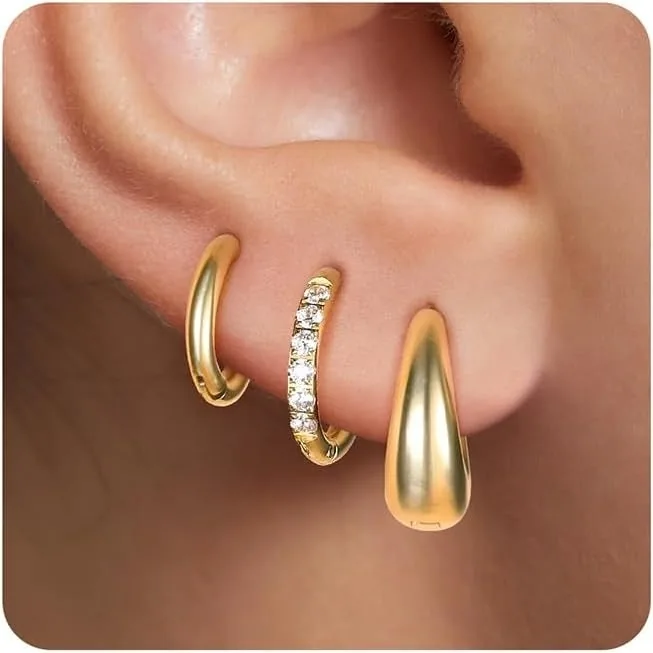
Comfort matters if you plan to sleep in your earrings. Flat-back studs and seamless huggies sit close to the ear and are much easier to rest on than posts with butterfly backs. If your ears react to cheaper metals, titanium, stainless steel and solid gold are the safest choices for anything you leave in for days.
Planning new piercings to build the stack? Professional piercers favor implant-grade titanium (often listed as ASTM F136) or solid 14K or higher gold for fresh piercings. Implant-grade steel contains nickel, so it is a poor choice if you react to it. Healing takes longer than most people expect: lobes typically need around six to eight weeks, while cartilage spots such as the helix often take six to twelve months or more. Swapping in fashion hoops or sleeping on a new cartilage piercing too early is one of the most common reasons it stays irritated.
Stacking rings without crowding your hands
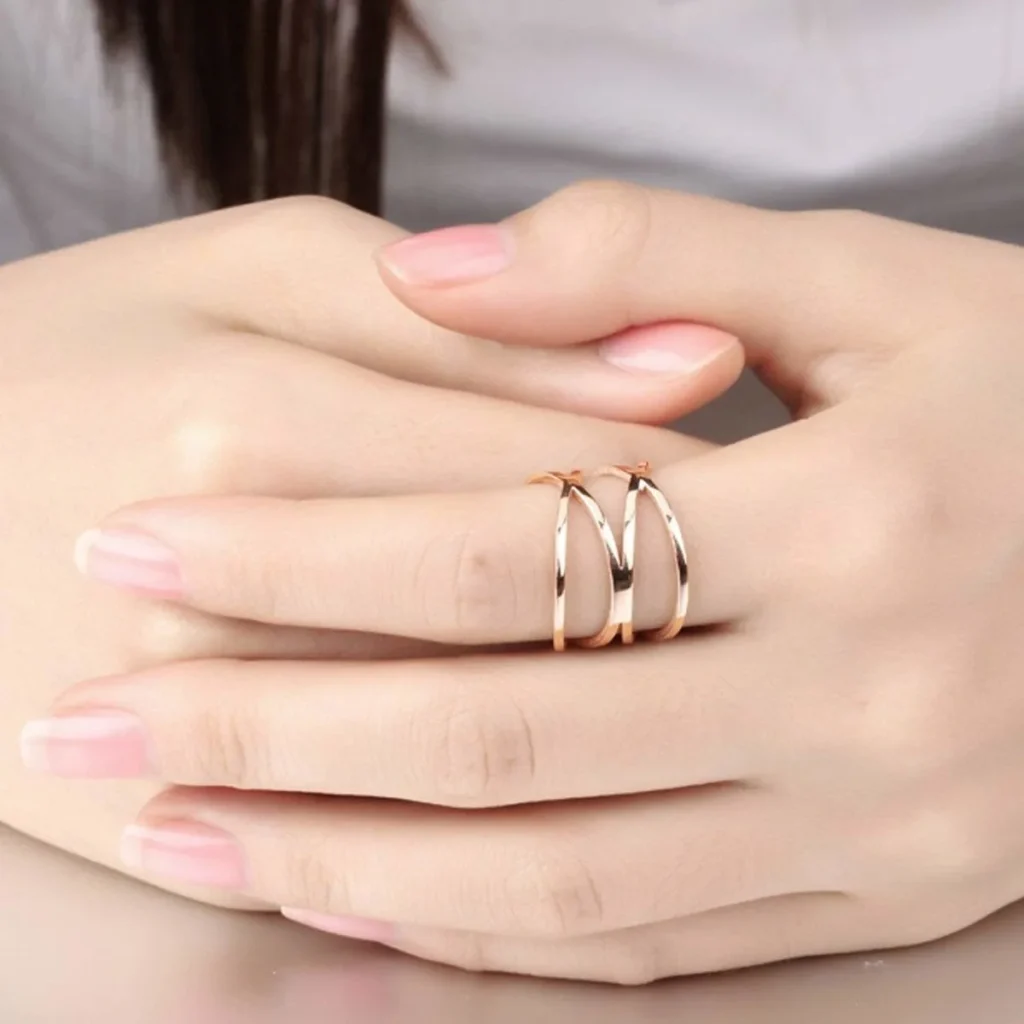
Rings look best when they are spread out rather than piled onto one finger. Try two or three thin bands on one finger, a single statement ring on the other hand, and leave at least one finger in between bare. Mixing textures, like a smooth band next to a twisted or hammered one, adds interest without adding bulk. If you wear an engagement ring, treat it as the focal point and keep the rings beside it slimmer. Several bands on one finger feel tighter together than any one alone, so check that the full stack still slides over the knuckle; our guide to finding your ring size at home explains how to size for stacks.
Bracelets and watches
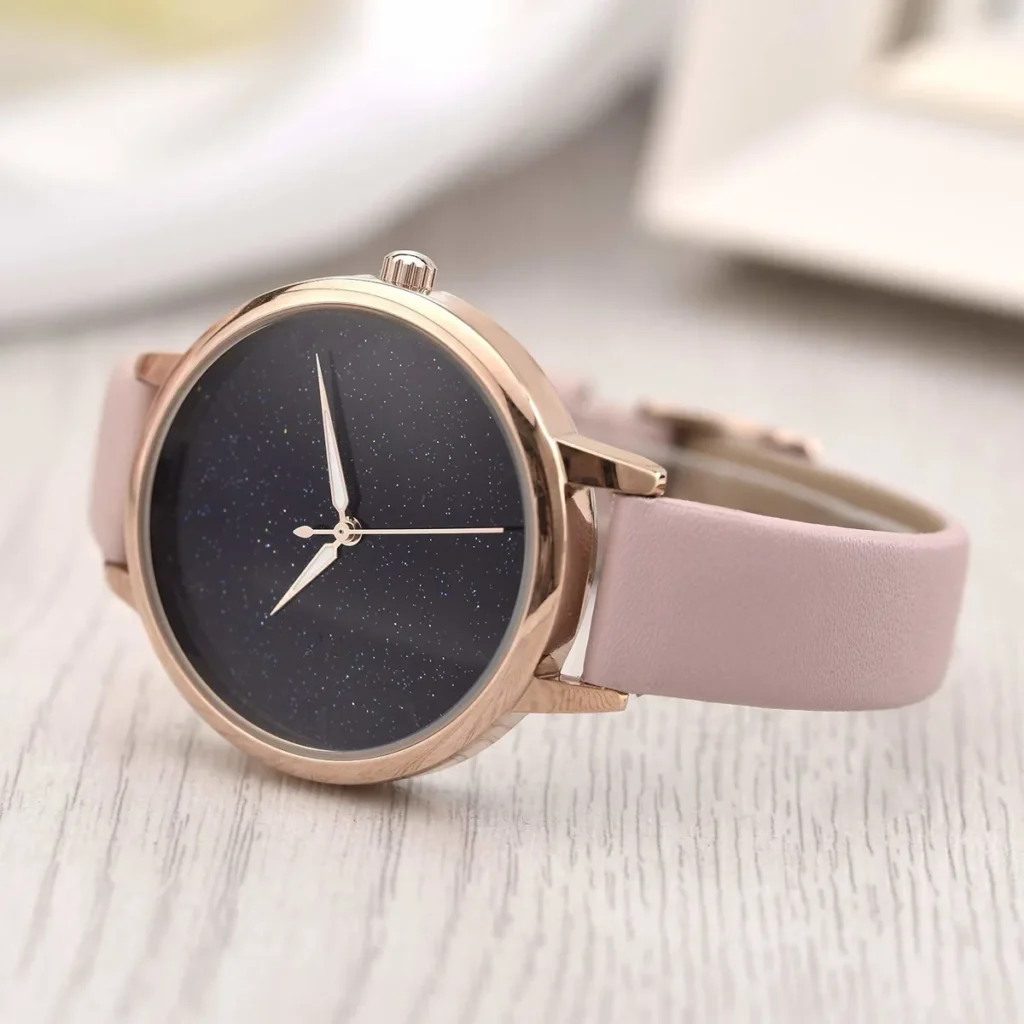
On the wrist, the same balance of fine and bold applies. A chain bracelet and a tennis bracelet work well together because one is textured and one is smooth. If you wear a watch, let it anchor the stack and keep the bracelets on the side away from your hand so the watch face stays easy to read. Stacking on your non-dominant wrist also means fewer scratches and less clanking on a keyboard.

Keeping layers from tangling
The most annoying part of layering is the knot at the back of the neck. A few fixes help: choose chains of slightly different weights, since heavier chains hold their position; fasten each necklace separately rather than all at once; and consider a layering clasp, a small bar that holds several chains apart at the back. When you take them off, lay each chain flat or hang it, rather than dropping them into one dish.
Two smaller details make a surprising difference. A heavy clasp on your shortest chain tends to slide around to the front and drag the others with it, so keep the top layer’s clasp light. And if your layers still knot, widen the gaps: chains about 3 to 4 inches (8 to 10 cm) apart overlap far less than chains spaced at 2 inches, especially if you move a lot during the day.
Quick Answers
How many necklaces is too many? Two or three layers suit most necklines. Four or more works when the chains are very fine and the neckline is open, but it starts to look busy with a crew neck.
Can I layer over a sweater or turtleneck? Yes, with longer chains of around 24 to 30 inches (61 to 76 cm) and a little more weight. Very fine chains and textured links can snag loose knits, so smooth, medium-weight links are the safer choice.
Should I sleep in layered necklaces? Better not. Even waterproof chains knot overnight, and fine chains can kink or snap under the pull.
When less is better
Layering is about rhythm, not quantity. If your earrings are big, keep the neck simple. If you are wearing a statement necklace, let your hands stay quiet. A good test before you leave the house: look in the mirror and remove one piece. If you do not miss it, it did not need to be there.
If you are starting from one chain, add a second two inches longer in a different texture and wear the pair for a week before adding a third. Need that second chain? Our picks of dainty necklaces to wear with everything are a good place to start, and there is more in Our Finds.